
What Size Air Compressor Do I Need?
Air compressor sizing should start with the required CFM and PSI, not horsepower alone. The right size depends on how much air your equipment uses at the same time, along with pressure drop and future growth. An undersized compressor can cause pressure loss, product quality issues, and downtime, while an oversized system can waste energy and increase operating costs. A compressed air assessment provides real operating data to help determine whether your system is properly sized and configured.

Quick answer: Start with CFM and PSI, not horsepower.
The right air compressor size depends on:- how much compressed air your operation needs (CFM)
- the pressure required at the point of use (PSI)
- how long and how often equipment runs
- how demand may change as your business grows
Horsepower matters, but it’s not the best starting point. Two air compressors with the same horsepower can deliver different airflow at a given pressure.
To get a rough estimate of what size air compressor you need, you can list the tools and equipment that use air, note each item’s required CFM and PSI, and think through which ones will actually run at the same time versus one at a time. For a simple setup, you can usually get close by adding up the tools that run together.
But in an industrial facility, demand isn’t always that predictable. If multiple compressors are running, different tools cycle on and off throughout the day, or production loads change by shift, then it may be better to have an assessment engineer measure your real operating data.
With more than 160 years of compressed air knowledge, Ingersoll Rand partners with businesses like yours to move from back-of-the-napkin estimates to air compressor systems designed around true demand. And when your system is properly sized and configured, the payoff can be huge. In 2025 alone, our team of assessment engineers uncovered over $20 million in energy savings for our customers.
What Factors Determine Air Compressor Size Requirements?
A common misconception is that compressor sizing begins with horsepower. Many people ask whether they need a 25 HP, 50 HP, or 100 HP compressor before they’ve figured out the airflow and pressure their equipment needs. Instead, you should ask yourself, “How much air do I need my system to deliver, at what pressure, and for how long?”
Horsepower still helps describe the motor driving the compressor, but it does not tell you the full amount of usable air a specific package will deliver. Compressor technology, operating pressure, efficiency and package design all affect performance. Compare the manufacturer’s rated airflow at the pressure your operation requires rather than treating horsepower as a universal CFM conversion.
CFM: The amount of air your operation needs
CFM, or cubic feet per minute, measures compressed air flow rate. Start by identifying the CFM requirement for each tool, production machine, and point of use. The total you need is based on the equipment that will operate at the same time, not necessarily every air tool in your plant.
PSI: The pressure required at the point of use
PSI, or pounds per square inch, measures pressure. Air can lose pressure as it moves from the compressor room through piping, filters, dryers, valves and other components, so size the system around the pressure needed at the point of use.
Many air tools use approximately 90 PSI as a common working pressure, but some applications, including spray guns, may operate at lower pressures. Always confirm the required pressure for each tool or process at the point of use.
HP: The power needed to deliver the required CFM and PSI
Horsepower describes the motor power available to drive the compressor. Once you know your required CFM and PSI, you can compare air compressors that are rated to deliver that flow at that pressure.
In general, higher CFM means the compressor must move more air, and higher PSI means it must work harder to compress that air. If the required airflow or required pressure goes up, the power needed to run the compressor usually goes up too.
Local site conditions
Your local site conditions, such as humidity, ambient temperature, air quality, and elevation, can influence how hard the compressor has to work and how much usable air it can deliver.
- In hot or high-elevation environments, lower air density may reduce how much usable air your compressor can deliver.
- Humid environments can also increase moisture load, making air treatment and dryer selection more important.
- If air quality is dusty, dirty, or contaminated, the system may need additional filtration or a different setup to protect equipment and maintain air quality.
That’s why compressor sizing should account for the actual conditions in and around your compressor room—not just the rated CFM, PSI, and horsepower.
Compressor size should also account for future growth
Your facility might grow in small, practical increments over the next few years: a new tool, extra operator, added line or longer shift. Over time, those changes can increase compressed air demand until the original system no longer fits your facility’s needs.
That doesn’t mean you need to buy the largest compressor available. Oversizing can create its own efficiency problems, so the goal is to balance room for realistic growth with the cost of producing more air than the facility needs.
How Do You Estimate Your Compressed Air Demand?
Smaller shops with a clear set of tools and predictable air use can often estimate compressor size by looking at real air demand. Start by identifying which tools need to run together, how much CFM they require, and what pressure they need to perform correctly.
Step 1: Make an equipment list
List every tool, machine, and process that will use your air compressor. Record the manufacturer’s required CFM and PSI for each one. If a specification gives a range, note the expected operating point rather than automatically using the lowest number.
Step 2: Identify what runs at the same time
Mark which air users can overlap during normal production and during realistic peak periods. Add the CFM requirements for those simultaneous users. Do not add every connected machine unless they truly operate together.
Step 3: Size to the required pressure
Confirm the highest pressure required at the point of use. Compare compressor capacity at that pressure because available CFM can change with operating pressure. Also account for known pressure drop through air treatment and distribution.
Step 4: Plan for realistic growth
Include documented plans for new equipment, additional shifts or higher production. You may also need extra capacity to handle normal changes in demand.
Example: Small body shop running three tools
Suppose a small auto body shop uses one air compressor for prep, paint, and general repair work. The numbers below are illustrative only; use the actual CFM and PSI requirements for your tools and operating setup.
Air user | Required flow | Required pressure | Runs during peak? |
|---|---|---|---|
Paint spray gun | 12 CFM | 40 PSI | Yes |
Dual-action sander | 15 CFM | 90 PSI | Yes |
Impact wrench | 5 CFM | 90 PSI | No |
In this example, the initial flow estimate is 27 CFM because the spray gun and sander may overlap during busy prep and paint work. The impact wrench is connected to the system but does not overlap with that peak. The spray gun operates at a lower pressure, but the shop still needs to size around the highest required point-of-use pressure, which in this example is 90 PSI.
The shop should also account for pressure drop through hoses and filters, air storage, air quality for painting, and any planned growth before choosing a compressor.
How do you estimate air compressor size when air demand isn’t as straightforward?
An estimate like the one above can be useful for a small, clearly defined application. But it’s not as helpful when air use changes throughout the day, production has grown, pressure problems are already showing up, or your system has been patched together over time.
In those situations, an Ingersoll Rand compressed air assessment can show how your system performs under real production demand. It can uncover issues like energy waste, leaks, pressure drops or times when demand outpaces supply, helping you avoid a compressor that’s too small to keep up or too large to run efficiently.
What Happens If Your Air Compressor Is Too Small?
Buying an air compressor that’s too small puts your facility at risk of drawdown: the moment when air demand outpaces the compressor’s capacity and system pressure starts to fall, even while the compressor is running at its limit.
Drawdown may not cause a full production shutdown, at least not at first. Early symptoms include pressure swings, inconsistent tool performance, quality changes, or equipment that struggles during busy production periods.
But if pressure and flow fall below what your operation needs, valves and other production equipment can fail, which can force you to stop production and miss daily targets. Pressure lower than system requirements can also cause poor product quality, leading to rework at best and requiring you to scrap the product at worst.
If your facility relies on compressed air to keep things moving, you can’t risk having an air compressor that doesn’t keep up with your demand.
Case Study: How Too Little Compressed Air Compromised Craft Beer Quality
A brewery owner in North Carolina said their business started with “tiny little compressor systems” because they were told that as long as they could put 120 PSI in the line at roughly 10 to 15 CFM, they would be fine. “That turned out to be not true very fast,” he said.
At first, the focus was on brewing beer. But then the brewery added kegging systems, keg-washing systems, and a bottling system—and the original compressors could no longer keep up with that added demand.
“By not keep up, I really mean they began to fail erratically,” he said.
And the problem wasn’t limited to the compressor room.
“We started noticing over time that when the pressure was inconsistent between our equipment, our overall beer quality went down,” he said. “So that became very important for us to fix.”
But the brewery team didn’t know what was causing the problems or how to fix it. They went to big-box shops and compressor shops asking for help, but they kept hearing a version of the same answer: you need a new compressor.
“We didn’t realize we needed one with enough volume, with enough pressure, with enough resiliency that the motor wouldn’t break down, and that wouldn’t throw oil into our product,” he said. “It’s taken us a long time to come to that conclusion, and it’s only through our partnership with Ingersoll Rand that we’ve come to understand the value of that.”
The Ingersoll Rand team took a practical approach, he said: the issue was not simply that the brewery needed “a compressor.” It was that the compressors they had were not designed for the way the brewery was actually operating.
“In this industry, you have to know the right companies to work with,” he said.
The key takeaway from this brewery’s story is that undersizing your air compressor might not shut down production—although it’s still a real risk—but it can still affect product quality. And if that happens, you could lose money through product you can’t sell, rework you didn’t plan for, or production time spent chasing a problem you may not know how to solve.
That's why it helps to work with a partner like Ingersoll Rand, with 160+ years of air compressor experience, who can look at how your system actually operates, meet you where you are, and help you choose a compressed air solution that supports efficient, reliable production.

What Happens If Your Air Compressor Is Too Large?
With how risky it can be to have an undersized air compressor, you might think buying extra capacity is the best defense against downtime. But oversizing your air compressor has downsides, too. An oversized compressor might make more air than your facility actually needs.
For centrifugal compressors, low demand can force the machine into blow-off, meaning excess air is vented instead of used. For rotary screw compressors, oversizing can lead to long unloaded run time or frequent load/unload cycling, where the compressor is still using energy without producing useful air.
Either way, the result is the same: you’re wasting money on compressed air that isn’t doing anything for your operation.
Case study: A 2026 assessment identified $400,000 in potential annual energy savings
In 2026, a large HVAC manufacturing facility wanted answers about the reliability and efficiency of its compressed air system. The customer had originally installed two centrifugal compressors in 2015, followed by two more units in 2017 (all four from one of our competitors). As reliability concerns grew, the customer brought in both Ingersoll Rand and another one of our competitors to evaluate the system.
The Ingersoll Rand team took a deeper look than flow meter readings alone: we reviewed supply-side data, flow meter information, and day-to-day operating behavior to better understand how the compressors were actually running.
That full-system assessment showed just how often the compressors were entering blow-off—and what that wasted air was costing the facility. The assessment identified approximately $400,000 in potential annual energy savings with an Ingersoll Rand solution.
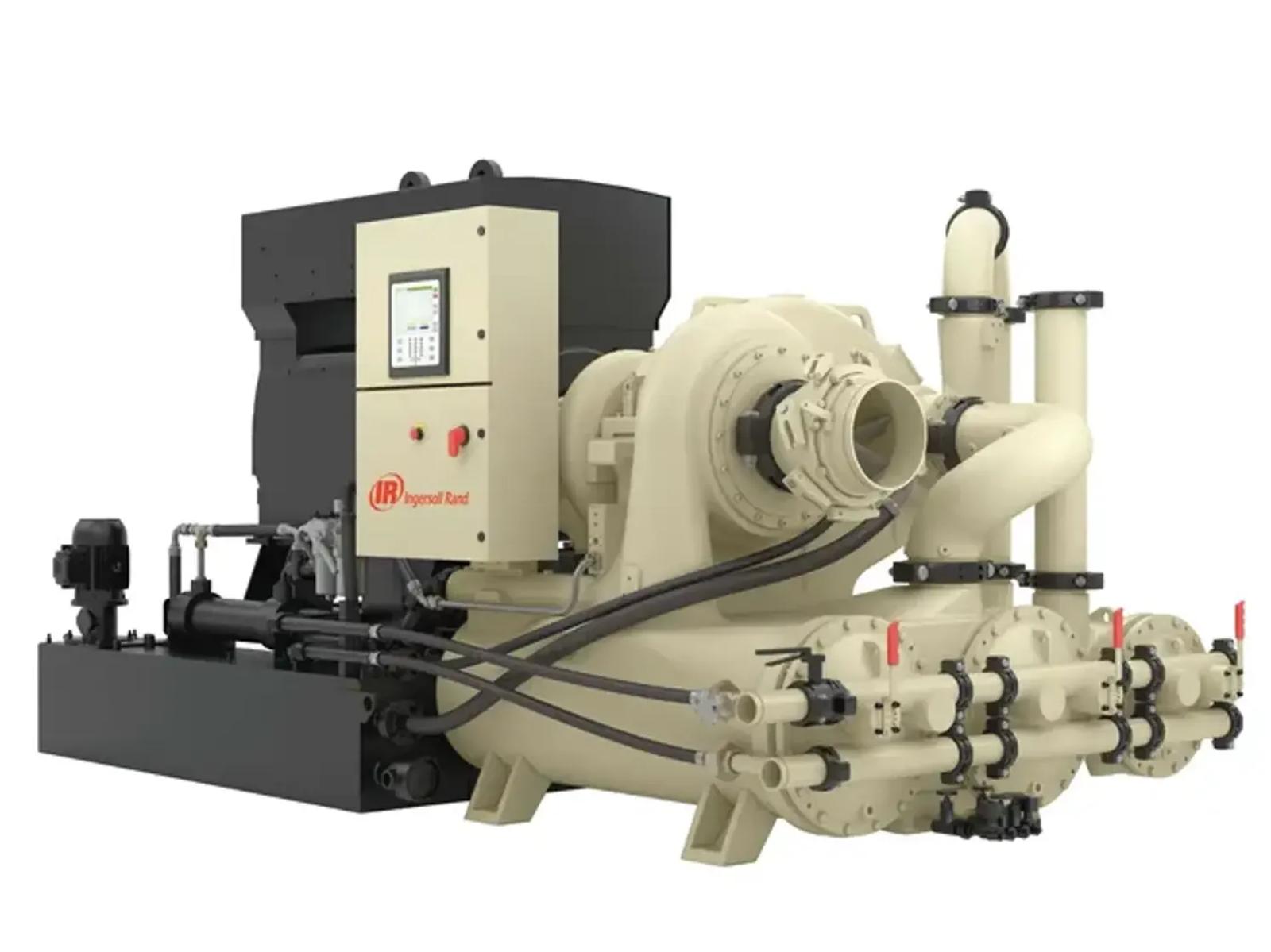
The customer ultimately chose to replace all four existing centrifugal compressors with four Ingersoll Rand NX-5000 units. According to the customer, Ingersoll Rand “knocked it out of the park” because the assessment went beyond the competition’s approach and helped them see exactly what the system needed.
And that $400,000 opportunity was not a one-off. In 2025 alone, Ingersoll Rand’s team of assessment engineers made recommendations projected to reduce customer energy use by 347,898,497.58 annual kWh. That adds up to more than $21 million in potential annual energy cost reduction for our customers.
How can you reduce downtime risk without oversizing your compressor?
If you’re worried about production downtime, the answer isn’t always to buy one oversized compressor and run it every day. Our team of assessment engineers recommends thinking in terms of N+1 redundancy instead. That means keeping one additional compressor, sized to match the largest operating unit, maintained, and ready as a backup.
The backup unit doesn’t need to run all the time, but it can be brought online if a primary compressor fails or needs service. This gives the facility a safer path to reliability without paying every day to operate more compressor capacity than production actually needs.
Next Step: Find The Best Air Compressor For Your Needs
Air compressor sizing starts with the air your facility actually needs: how much CFM your equipment requires, the PSI needed at the point of use, and which tools, machines, or processes run at the same time. Horsepower matters, but it should come after you understand your real air demand.
For a small shop with predictable air use, a rough estimate may be enough to narrow your options. But for industrial applications, variable demand, multiple compressors, pressure issues, or planned growth, you may benefit from a compressed air assessment.
With over 160 years of air compressor experience, Ingersoll Rand works with businesses like yours to help identify the best setup for reliability, energy efficiency, air quality, and long-term performance.
Now that you understand what goes into answering, “What size air compressor do I need?” the next step is to talk with an expert. Contact Ingersoll Rand so we can help you narrow down the best air compressor for your needs.
Frequently Asked Questions About Air Compressor Size
Each air tool or piece of equipment should list how much air it needs, usually as CFM at a specific PSI. You can typically find this in the manufacturer’s manual, data sheet, equipment specs, or from the supplier. To estimate your compressor size, add up the CFM for the tools and equipment that will run at the same time. Then account for pressure losses, normal operating variation, and any planned growth. If your system is more complex, verify the estimate with measured demand instead of relying on the rough calculation alone.
REACH OUT TO US